

Updates
Hazardous Fuel Reduction in Pescadero Canyon, Carmel-by-the-Sea
ChatGPT Summary of Planning Commission Staff Report & Resolution
Click image to download PDF
Another Interesting Observation
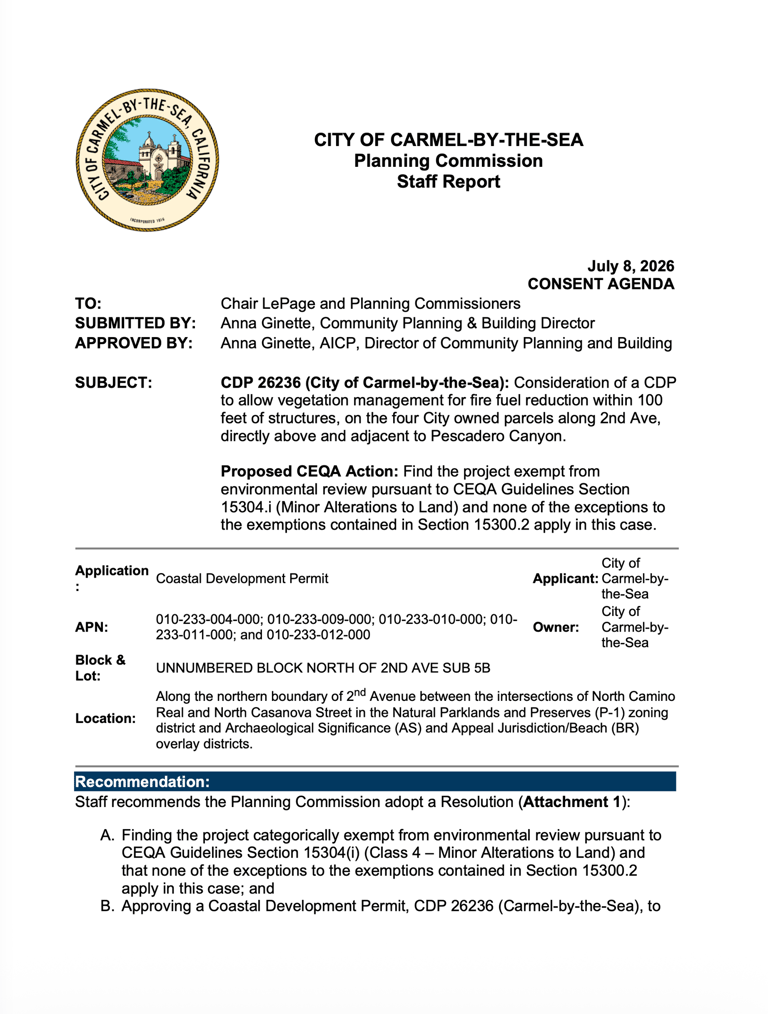
The staff report says:
"Implementation of the project would provide fire protection to nearby properties by reducing fuel loads."
That is a significant statement.
The City is officially recognizing that fuel loads presently contribute to wildfire risk. This actually aligns very closely with the position Carmel Fire Goats has advocated for over the past year.
However...
One thing surprised me. The permit is not for all City-owned land in Pescadero Canyon. It is specifically for vegetation management within 100 feet of structures
That means the permit is structure-driven, not parcel-driven. If large areas of City-owned canyon lie farther than 100 feet from structures, this permit would not authorize work there.
That is an important distinction.
Another subtle change: earlier discussions surrounding the Carmel Fire Goat's petition often focused on clearing City-owned parcels because they represented the majority of the hazardous fuel.
These documents shift the emphasis from "clear the City's vacant parcels" to "create defensible space around existing homes."
Those are related objectives, but they are not identical.
Overall Assessment
Here's a document summary:
Yes, they support the central premise that hazardous vegetation should be reduced to lower wildfire risk.
They represent a notable policy shift because the City is now formally pursuing fuel mitigation on these parcels.
However, the project is much narrower than a comprehensive canyon fuel-reduction effort. It is carefully tailored to satisfy Coastal Act requirements and a CEQA categorical exemption by limiting work to vegetation management within 100 feet of structures, preserving trees, and minimizing environmental impacts
One additional point caught my attention: the map in Exhibit B (page 10 of the resolution) outlines the proposed treatment area and labels it as the "Pescadero Canyon Proposed Project."
Visually, it appears focused on the interface between the City-owned parcels and the adjacent residential neighborhood, rather than on the entire canyon, reinforcing that this is a defensible-space project rather than a full canyon restoration effort.
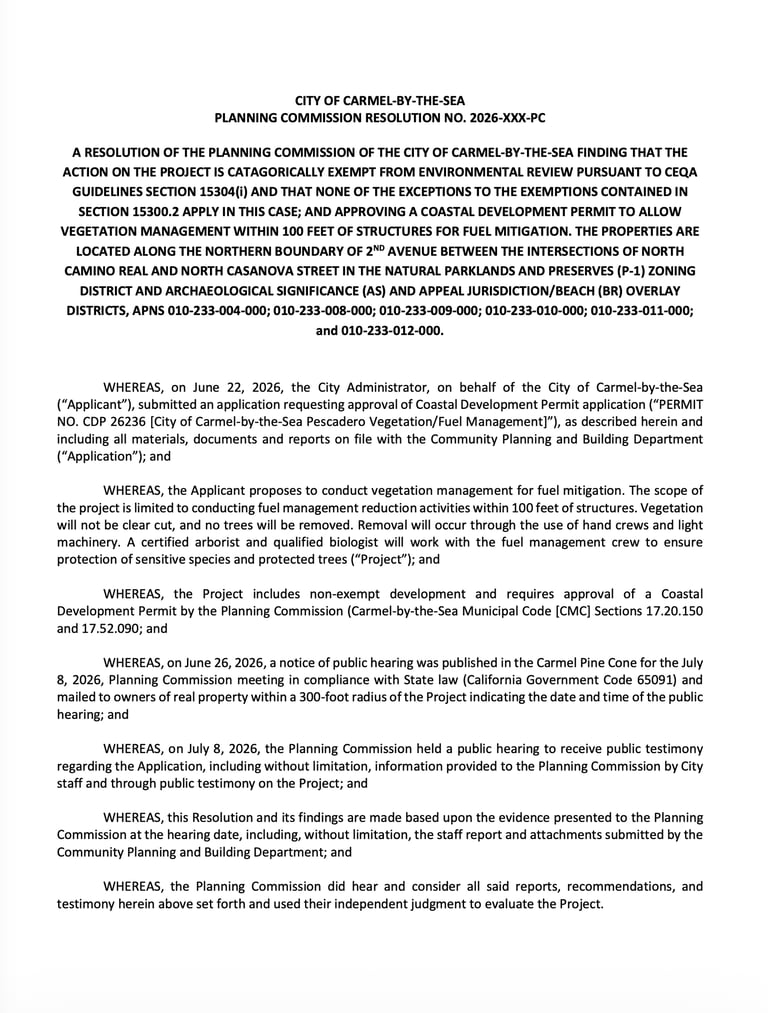
After reviewing both documents (shown below), they largely support Carmel Fire Goat's core premise, but they also reveal something important that goes beyond it.
Carmel Fire Goats Premise
The City should clear hazardous fuel on its vacant parcels to reduce the chance of a devastating wildfire.
The documents explicitly support this.
City Statements
the purpose of the project is "vegetation management for fuel mitigation" on City-owned parcels in Pescadero Canyon,
the work is intended to reduce fuel loads,
the work will provide fire protection to nearby properties, and
the area qualifies because of extra hazardous fire conditions requiring 100 feet of fuel clearance around structures
In other words, the City is now officially acknowledging that hazardous vegetation exists and that reducing it improves fire safety.
Something Else Is Happening
The documents reveal that this is not a general canyon fuel-reduction project.
Instead, it is a very narrowly crafted regulatory permit designed to fit within a specific CEQA exemption.
Throughout both documents, the same limitations are repeated:
only vegetation within 100 feet of structures
no clear-cutting
no tree removal
hand crews and light machinery
arborist supervision
biologist supervision
Coastal Development Permit approval
Those limitations appear over and over because they are necessary to qualify for the CEQA §15304(i) categorical exemption.
So The Driving Force of These Documents Is Not:
"Let's clean up Pescadero Canyon."
It is more accurately:
"Let's approve only the amount of vegetation management that qualifies for this particular Coastal Development Permit and CEQA exemption."
The City Is Also Making a Legal Argument
Notice the language. The resolution repeatedly argues that the project:
will not significantly affect the environment
enhances open space
protects sensitive habitat
does not require tree removal
does not create cumulative impacts
is exempt from CEQA
Those are legal findings necessary to defend the permit if challenged.
Call/Email the City Sign the Petition Donate ©2026. All rights reserved. Privacy policy